
Cloud Infrastructure
Cloud built to a budget you set in advance. Right-sized, tagged and reviewable, not a bill nobody can explain.
Built to a number you agree first
Cloud costs drift because nobody set a boundary at the start. Budgets, tagging standards and alerts are configured during the build, so a runaway environment announces itself in week one rather than on the invoice at month end.
- Cost controls, budgets and tagging standards
- Right-sizing against measured usage
- Spend visibility by project or cost centre
From first call to steady state
- 01
Landing zone
Account structure, identity, network, and tagging standards designed first.
Everything built later inherits these, so getting them right matters. - 02
Migration plan
Workloads assessed and sequenced by risk and dependency.
Not everything belongs in the cloud; we will say so where it does not. - 03
Build and migrate
Infrastructure as code, staged migration, and rollback at each step.
Repeatable builds rather than hand-configured servers. - 04
Operate
Budget alerts, backup verification, and failover drills on a schedule.
Recovery is proven by drill, not by a backup job completing.
This is usually when we get the call
- The cloud bill varies wildly and nobody can explain the changes
- Environments were built by hand and cannot be rebuilt reliably
- There are no budget alerts, so overspend is discovered at month end
- Backups exist but failover has never been tested
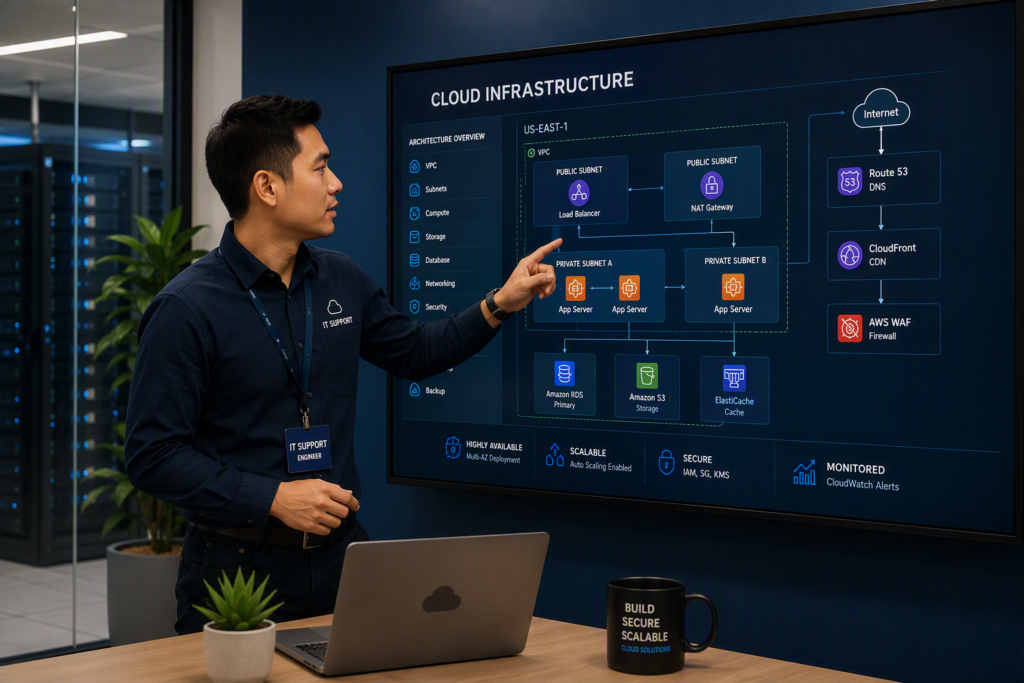
Repeatable builds and recovery you have tested
Hand-built environments drift apart and cannot be rebuilt reliably under pressure. Infrastructure as code keeps environments reproducible, and failover drills prove recovery works before you depend on it.
- Cloud architecture and landing-zone design
- Infrastructure as code for repeatable builds
- Backup, disaster recovery and failover drills
Scope, spelled out
- Cloud architecture and landing-zone design
- Migration of servers and workloads from on-premise
- Identity, network and storage foundations
- Cost controls, budgets and tagging standards
- Backup, disaster recovery and failover drills
- Infrastructure as code for repeatable builds
Straight answers
How do you stop costs running away?
Budgets, tagging standards, and alerts are configured during the build rather than added after the first surprise invoice. Tagging is what makes cost visible by project or cost centre, and it is decided up front because retrofitting it is tedious.
Is everything going to the cloud?
No, and it should not. Some workloads are cheaper or more reliable on site. We assess each and will recommend keeping things local where that is the better answer.
What if we need to move back on-premise?
Infrastructure as code and documented architecture make moving in either direction a project rather than a rebuild. Avoidable lock-in comes from hand-configured environments, so we do not create them.
How is our data protected?
Identity, network, and storage foundations are designed as one piece, with backup verified by restore and failover tested by drill. Encryption and access control follow your existing policy or, if you do not have one, we will say that plainly. A common finding during assessment is that encryption is enabled on stored volumes but not on inter-service traffic, and that is the kind of gap a design review surfaces before it becomes an audit finding.
Before the first call
- A realistic monthly budget expectation
- A list of workloads and their interdependencies
- Your identity provider details, or agreement to use the cloud native option
- A maintenance window for migration work
Most delays in any engagement trace back to access, decisions, or content. Naming these up front is what keeps a project on schedule.
Services that pair with this one
Ready to start?
Tell us what you are working with and we will tell you plainly what it takes. No obligation, no pressure.