
AI Readiness & Assessment
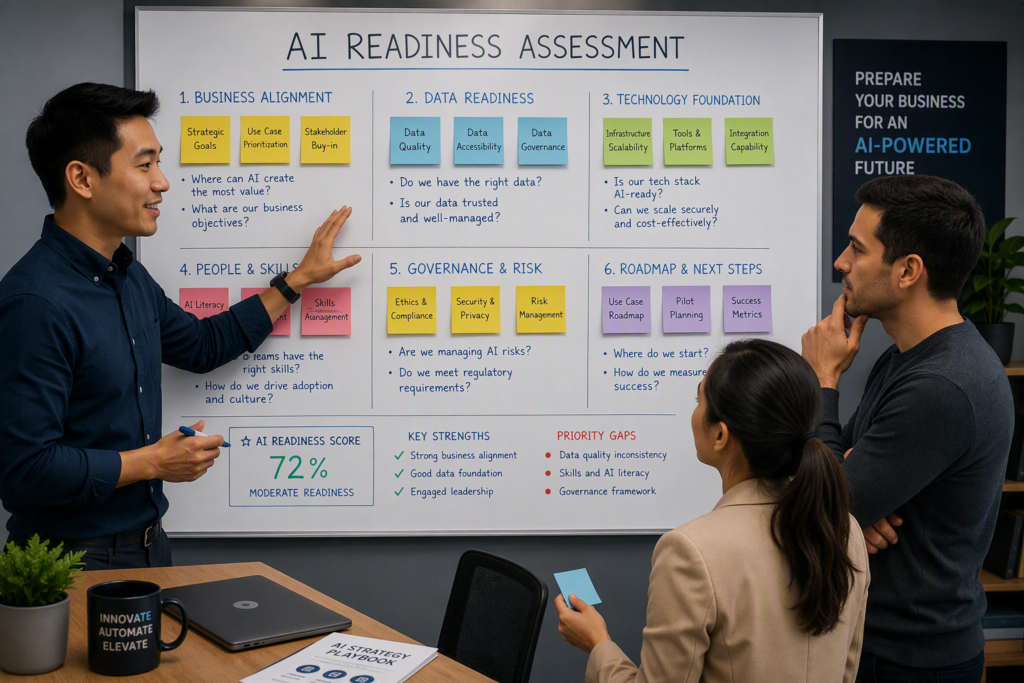
We assess your data, systems and workflows, then tell you plainly which AI use cases are worth pursuing and which will not survive contact with your real operations.
This is usually when we get the call
- Staff already use public AI tools with company data and nobody approved it
- Leadership has been offered AI projects but cannot tell which are real
- Data exists across systems that do not talk to each other
- A previous AI pilot faded out without a clear reason recorded
An honest shortlist, including the word no
Most AI proposals are a list of everything a model could theoretically do. The useful version is short, ranked by what would actually pay back in your business, and clear about which ideas should not be started at all.
- Use-case shortlist scored by value and effort
- Data readiness and quality assessment
- Licensing and cost modelling before commitment
Data, privacy and exposure checked first
AI projects fail on the boring parts: data in the wrong place, unclear ownership, and obligations nobody read. We review what you hold, where it sits and what rules apply, so the roadmap accounts for them from the start.
- Security, privacy and data-protection exposure review
- What data may reach a model, and what may not
- A written roadmap you can act on
From first call to steady state
- 01
Discovery
Interviews and a review of the data, systems, and workflows that would be involved.
Typically 1 to 2 weeks for a mid-sized business. - 02
Assessment
Data quality, integration feasibility, and regulatory exposure reviewed per use case.
Uncomfortable answers are included, not filtered out. - 03
Scoring
Use cases ranked by value against effort and risk, with cost modelled.
The list is short on purpose; a long list usually means nothing gets built. - 04
Roadmap
A written plan with sequencing, owners, and a sensible first project.
You own the document, whether or not you engage us for the build.
What the assessment week looks like
We map your systems, data locations, and the workflows that eat the most hours. No recommendation happens before this is honest.
AI is only as good as the data it can reach. We check what is documented, what is scattered, and what is in someone’s head.
Candidate uses ranked by hours saved, risk and effort. Most lists shrink from twenty ideas to two or three worth doing.
Findings, a ranked plan, and what it would cost – including the honest answer ‘not yet’ where it applies.
We present to you and your team, answer the hard questions, and leave the document with you whether or not you proceed.
The deliverable is yours to keep and to show any other provider. If nothing is worth automating yet, the report says so – that is a valid outcome, and a cheap one compared to finding out after buying tools.
Scope, spelled out
- 01Data readiness and quality assessment
- 02Use-case shortlist scored by value and effort
- 03Security, privacy and data-protection exposure review
- 04Licensing and cost modelling
- 05A written roadmap you can act on
Before the first call
- Short interviews with the people who run the affected processes
- A view of where relevant data lives and who owns it
- Your regulatory or contractual constraints, in writing
- A sponsor who can act on the roadmap afterwards
Most delays in any engagement trace back to access, decisions, or content. Naming these up front is what keeps a project on schedule.
Straight answers
What do we actually receive at the end?
A written roadmap: the use cases that survived scrutiny, ranked by value against effort, with cost modelled and a sensible first project identified. It is yours to act on, with us or with someone else.
How long does the assessment take?
Typically one to two weeks for a mid-sized business, depending on how accessible your data and systems people are. The bottleneck is usually interview availability rather than analysis.
Will you tell us if AI is not worth it for us?
Yes. That is a legitimate finding. Most businesses have two or three genuinely worthwhile use cases and a much longer list that would not survive contact with real operations. Saying so is cheaper for you than building the wrong thing.
Do we need clean data first?
Not necessarily clean, but you need to know where the problems are. Data quality assessment is part of the work, and a use case that depends on unreliable data is ranked accordingly rather than quietly assumed to be fine.
Do we have to buy AI services from you afterwards?
No. The assessment is standalone and the report is written so any competent provider could implement it. If we do the work, the scope and price are quoted from the same document – no discovery rerun, no duplication.
What does the assessment cost relative to the work itself?
A small fraction of the first automation project – and it is the piece that stops you buying the wrong one. Most clients recover the fee the first time the report says ‘not this tool’, which it does more often than you would think.
Services that pair with this one
Who this is for
Leadership teams hearing ‘we should use AI’ from every direction and wanting one grounded answer instead of twelve demos.
Businesses about to spend on tools and wanting to know which spend would actually pay back.
Anyone seeking a report that says yes because the budget is already approved. You are paying for honesty about the two or three things worth doing.
Ready to start?
Tell us what you are working with and we will tell you plainly what it takes. No obligation, no pressure.