
App Development
Internal tools and customer apps for the devices your team actually carries, shipped in small, reviewable releases.
This is usually when we get the call
- Field staff photograph paperwork and re-type it at the office
- Your team uses a spreadsheet over WhatsApp because there is no better tool
- The system you have was built for desktop and is unusable on a phone
- Data arrives at head office a day late and nobody trusts the numbers
From first call to steady state
- 01
Discovery
We define the one job the app must do well, and who uses it in what conditions.
Network conditions and device fleet are checked here. - 02
Prototype
A tappable prototype to react to before any production code is written.
Cheaper to change a prototype than a finished app. - 03
Build
Small, reviewable releases with the integration work happening alongside.
You review each increment as it lands. - 04
Release and upkeep
Store submission, staged rollout, and a plan for updates and OS changes.
Store review timelines are outside our control and planned for.
Built for the network your team actually has
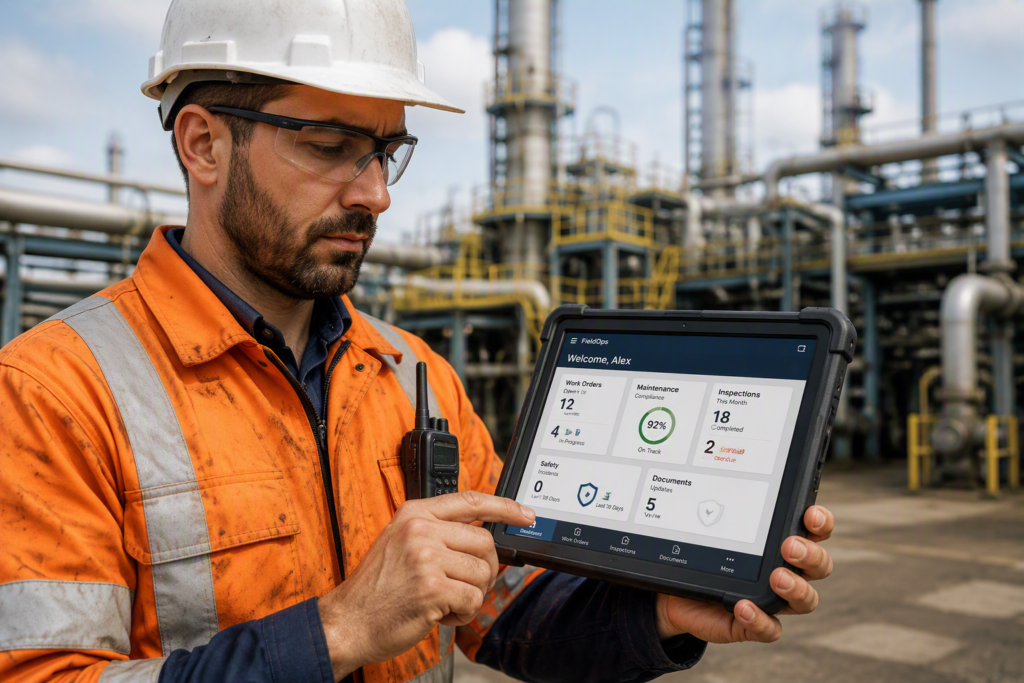
Field teams work in basements, warehouses and vans where signal drops. An app that assumes perfect connectivity fails exactly where it is needed most, so offline tolerance is designed in from the start rather than patched in later.
- Offline-tolerant data capture and sync
- Role-based access for different crews
- Integration with the systems you already run
Scope, spelled out
- 01iOS and Android apps from a single codebase
- 02Internal tools for field and warehouse teams
- 03API design and integration with your existing systems
- 04Offline-tolerant data capture and sync
- 05Push notifications, identity and role-based access
- 06App Store and Play Store submission and upkeep
Small releases, fewer surprises
A six-month build that appears all at once is impossible to review and expensive to change. We ship in small, reviewable increments so you see progress early and can redirect before the wrong thing is finished.
- API design and integration with existing systems
- Push notifications and identity management
- App Store and Play Store submission and upkeep
Straight answers
Do we need two separate apps for iOS and Android?
Usually not. A single codebase covers both for most internal tools and many customer apps. Where a platform-specific capability genuinely requires native code, we flag it at scoping with the cost implication rather than discovering it mid-build.
What happens when the phone has no signal?
For field and warehouse tools we design for offline use: data captured locally, queued, and synced when connectivity returns. This is a design decision made at the start, not something bolted on afterwards.
How do updates work after launch?
Releases are small and reviewed as they land. Operating system updates happen yearly and can break things, so ongoing upkeep is part of the arrangement rather than assumed. Store review times are outside our control and are planned around.
Will it work with our existing systems?
That depends on whether those systems expose an API. Where they do, integration is usually straightforward. Where they do not, options are database-level integration, a middleware layer, or replacing the bottleneck. We assess this during discovery and give you the honest version.
Before the first call
- The people who will actually use the app, available for short interviews
- Access to the systems it must integrate with, or their documentation
- A decision-maker for scope questions during the build
- Sample data that reflects real usage, with sensitive details removed
Most delays in any engagement trace back to access, decisions, or content. Naming these up front is what keeps a project on schedule.
Services that pair with this one
Ready to start?
Tell us what you are working with and we will tell you plainly what it takes. No obligation, no pressure.